


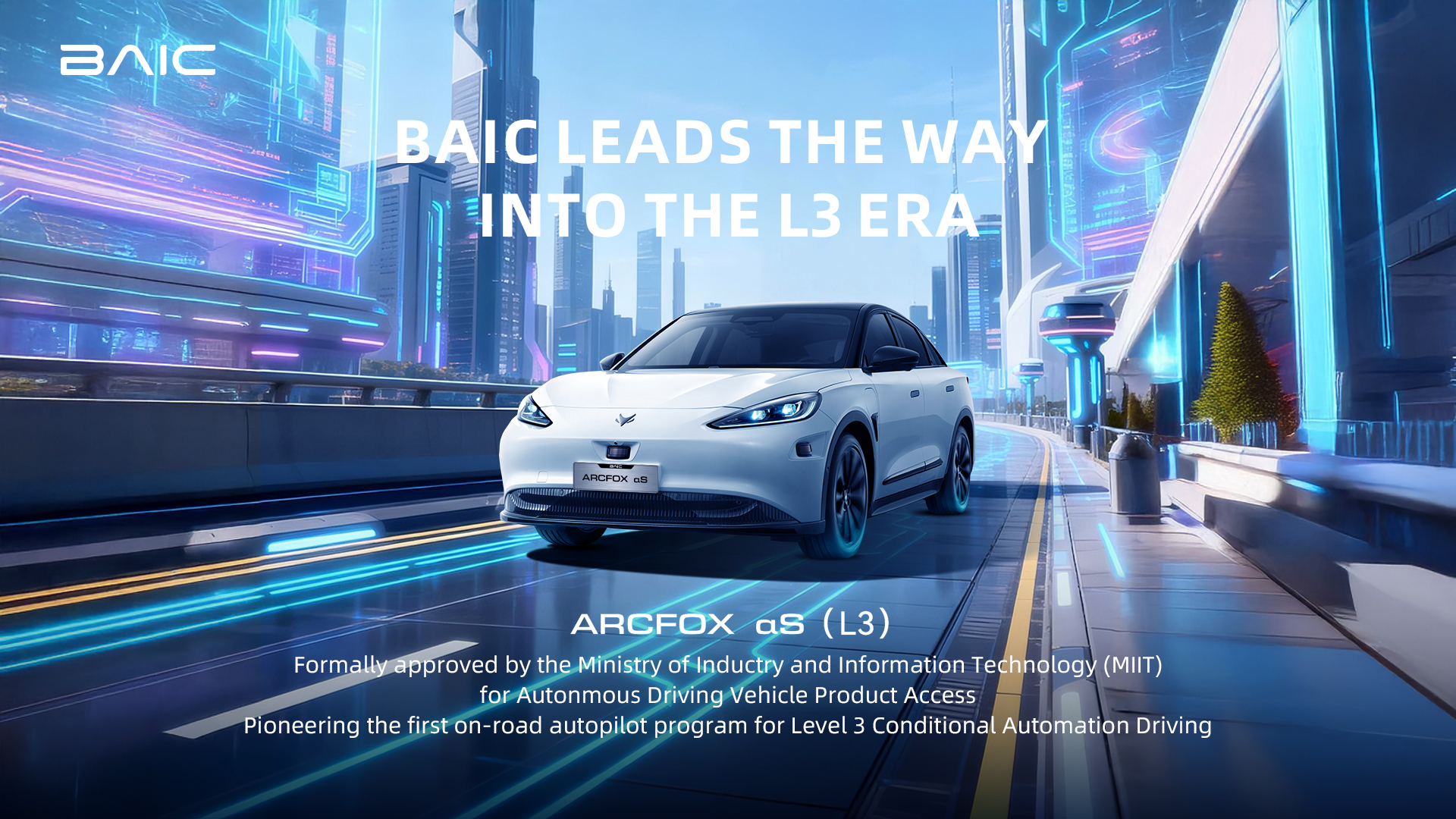
The approval of the ARCFOX Alpha S (L3 Edition) for conditional automated driving pilot operations marks a defining moment not only for BAIC Group, but also for China’s intelligent connected vehicle industry. Granted by the Ministry of Industry and Information Technology, the L3 product access approval signals a shift from technical validation to early-stage commercial application, underscoring the growing maturity of autonomous driving technologies in China.
At the core of this achievement lies BAIC Group’s unwavering philosophy: safety is the lifeline of autonomous driving. Rather than treating autonomy as a purely technological pursuit, BAIC has elevated safety to a group-level strategic priority, embedding it across enterprise governance, product development, and real-world operations.
Since 2024, under its “Three-Year Leap Forward Initiative,” BAIC has comprehensively restructured its intelligent connected vehicle framework. This transformation spans the entire value chain—from research and development to manufacturing, validation, operations, and aftersales services—enabling the group to support mass-production and deployment of L3 and higher-level autonomous vehicles.
What sets BAIC apart is its system-level approach. Beyond vehicle hardware and software, the company has built a comprehensive safety assurance ecosystem that integrates functional safety, safety of the intended functionality (SOTIF), cybersecurity, data security, software update management, risk control, and emergency response. This holistic structure ensures that autonomous vehicles are not only technologically capable, but also operationally safe and socially trustworthy when deployed on public roads.
Systematic Innovation: “One Core, Three Rings” Safety Architecture
To translate safety philosophy into engineering reality, BAIC has developed a “one core, three rings” full-lifecycle safety assurance system.
One Core: System-Guaranteed Safety
At its heart is a development philosophy centered on system-guaranteed safety. BAIC has reconstructed its autonomous driving development process so that safety requirements are embedded from concept definition through system design and verification. Modular development processes, combined with a dual closed-loop verification mechanism and three-level review system, ensure that safety and performance evolve together throughout development.
Three Rings: Full-Lifecycle Protection
- Testing & Verification Ring:
An industry-leading “three-pillar” validation framework combining simulation testing, closed-track testing, and open-road testing. This approach ensures alignment with China’s complex and diverse traffic environments. - Process Safety Ring:
A “five-in-one” safety management system covering functional safety, SOTIF, cybersecurity, data security, and software update security. A defense-in-depth architecture coordinates cloud, network, and vehicle-end protection across the entire vehicle lifecycle. - Operational Monitoring Ring:
A centralized autonomous driving safety monitoring platform enables 24/7 vehicle status tracking, data analysis, and rapid emergency response—creating a closed loop of monitoring, feedback, and continuous optimization.
Engineering Practice: ARCFOX Alpha S (L3 Edition)
Multi-Layer Redundant Architecture
The ARCFOX Alpha S (L3 Edition) embodies BAIC’s safety philosophy through a highly redundant software and hardware architecture. It is equipped with 34 high-performance sensors, including three LiDAR units, delivering 360-degree environmental perception. Drawing from aviation-grade safety principles, redundancy is built into perception, decision-making, steering, braking, communication, power supply, and positioning systems.
Even in the event of isolated system failures, backup systems ensure controlled and predictable vehicle behavior. A comprehensive autonomous driving data recording system further supports traceability, post-event analysis, and continuous improvement.
Rigorous Testing and Validation
BAIC set a clear safety benchmark for its L3 product: performance safer than an attentive human driver. To validate this target, the ARCFOX Alpha S (L3 Edition) has completed over 800,000 equivalent kilometers of testing, covering its full operational design domain.
Testing spans not only autonomous driving functionality, but also functional safety, SOTIF, cybersecurity, data protection, and software update security—establishing a robust foundation for future large-scale deployment.
Detailed Specifications (L3 System Overview)
- Vehicle: ARCFOX Alpha S (L3 Edition)
- Autonomous Level: L3 Conditional Automated Driving
- Sensor Suite:
- 34 sensors total
- Includes 3 LiDARs
- Perception Coverage: 360-degree full-surround awareness
- Safety Architecture:
- Full-chain redundancy (perception, control, braking, steering, power, communication)
- Testing Mileage:
- 800,000+ equivalent kilometers
- Safety Domains Covered:
- Functional safety
- SOTIF
- Cybersecurity
- Data security
- Software update security
- Operational Monitoring:
- 24/7 real-time safety monitoring platform
Highlights
- First BAIC autonomous vehicle to receive China’s L3 product access approval
- Safety elevated to a group-level strategic priority
- “One core, three rings” full-lifecycle safety assurance system
- Aviation-inspired multi-layer redundant architecture
- Comprehensive testing across real-world and simulated scenarios
- Integrated operational monitoring for public-road deployment
- A clear pathway from pilot operation to commercial application
News Source: BAIC MOTORS
